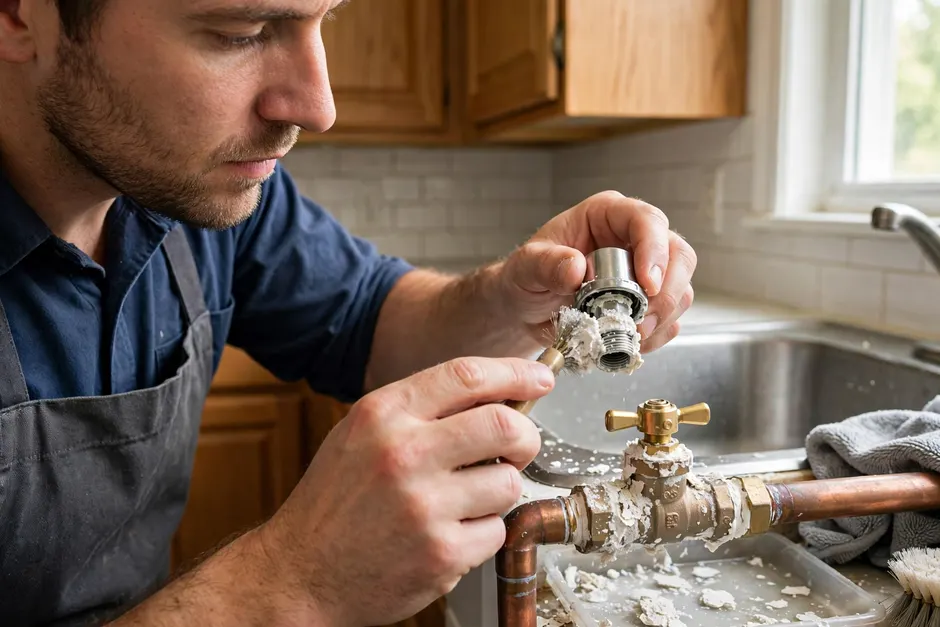
Thompson's Station sits on Middle Tennessee limestone, and water travelling through it picks up calcium and magnesium on the way. That mineral load is safe to drink, but it scales water heaters, crusts fixtures, eats anode rods and narrows pipes over years. The countermeasures are known and ordinary: flush heaters yearly, check anodes, descale tankless units, and soften the water if the scale battle is one you are tired of fighting room by room.
Where the minerals come from
Rain falls soft. It is the ground that hardens it. Williamson County's bedrock is rich in limestone, and groundwater dissolving through it arrives at your tap carrying the county's geology in solution. HB&TS Utility District supplies water across this area, treated and safe, but treatment for safety is not softening, and the hardness that leaves scale on a Thompson's Station shower door is well within normal, healthy water. Move twenty miles in any direction here and the story barely changes. It is a Middle Tennessee condition, not a defect in anyone's supply.
Heat is what makes hardness visible. Cold hard water keeps its minerals dissolved and behaves itself. Heat it, and the minerals precipitate as scale exactly where the heat is: heater elements, tank floors, heat exchangers, kettle bottoms. That is why the water heater is always the first casualty, and why the maintenance rhythm in this town is written around it.
What it does, room by room
In the utility room: sediment in the tank, an anode consumed quietly protecting it, an expansion tank working harder against pressure as passages narrow. In the kitchen: aerators and dishwasher inlets crusting until flow embarrasses itself, glassware filming no matter the detergent. In bathrooms: shower heads needling into uneven sprays, cartridges stiffening, toilet fill valves catching grit and refusing to close fully (a running toilet with a geological excuse). On pipe walls, especially older galvanised and cast iron: a slow internal narrowing that drops pressure a little each year.
None of this arrives as a crisis. It arrives as a gradient, which is why owners adapt to it and blame the house, the appliances or their own luck. The day a flushed heater recovers its pace or a descaled shower head sprays like new, the gradient becomes obvious in reverse.
The countermeasures, in order of effort
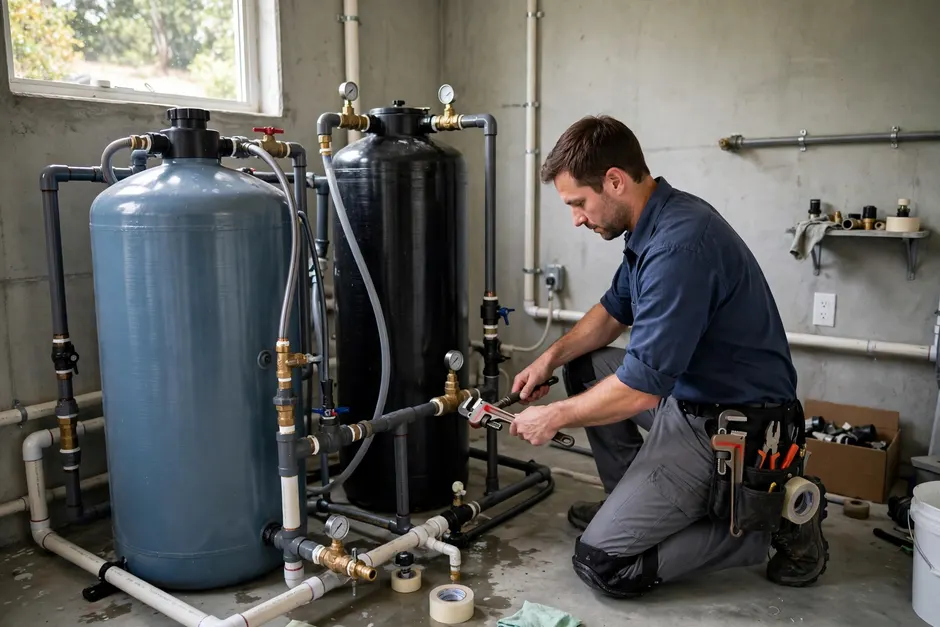
First, maintenance rhythm: flush the tank yearly (six-monthly for very hard or high-use homes), descale tankless units yearly, check the anode every two to three years, sooner with a softener fitted. Second, small fittings: clean aerators and shower heads in vinegar or replace them for pennies, fit grit-resistant fill valves, keep softener salt topped up if you have one. Third, treatment: a correctly sized softener removes hardness at the door, and filtration handles taste, smell and sediment, which are separate complaints often confused with hardness.
What does not work: magnets and miracle conditioners with claims no test supports, and ignoring the heater while polishing the taps. Spend on the order above and the geology loses. Our softeners page explains sizing and the test-first approach, and the flush article covers the heater routine in full.
Living with limestone like a local
Thompson's Station homeowners who thrive with this water share a posture: they expect scale, they schedule against it, and they do not let a young heater become an old one through neglect. New arrivals from soft-water regions need a season to recalibrate what normal maintenance means here, and builders' manuals written for the whole country will undersell the local rhythm every time. Trust the shower door. It is the most honest water report in the house.
| Sign | What it points to |
|---|---|
| White crust on taps and shower door | Surface scale; clean, consider softening |
| Rumbling tank, slower hot water | Sediment; flush now, anode check |
| Tankless temperature swings | Exchanger scale; descale |
| Pressure fading over years | Internal narrowing; have the lines assessed |