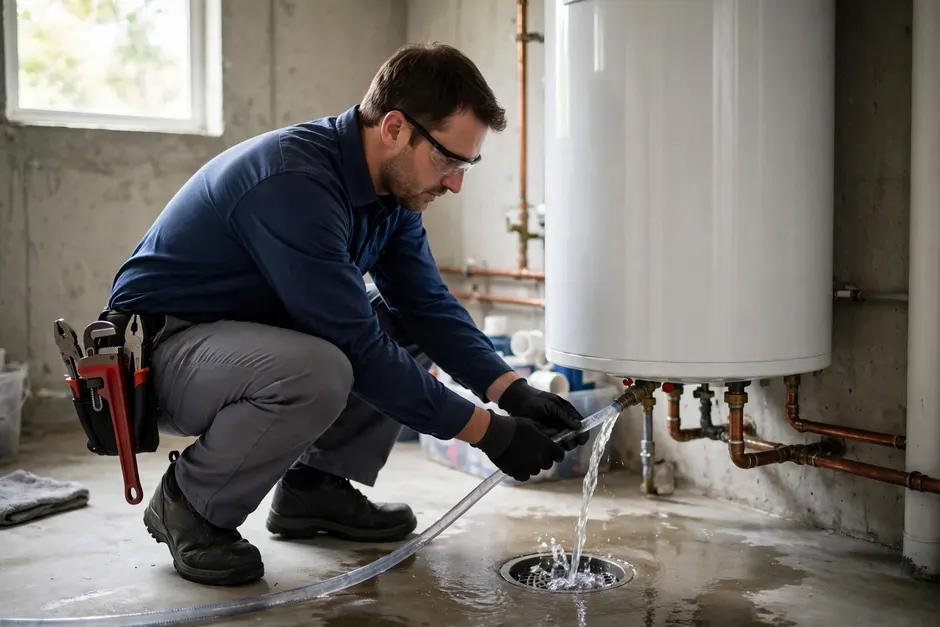
In Thompson's Station, once a year is the baseline, because our water carries enough limestone mineral to lay down real sediment in twelve months. Homes with very hard water, a softener feeding an ageing tank, or heavy hot water use may benefit from every six months. A tank that rumbles is already telling you it is overdue. The flush itself is simple maintenance with a few traps for the unwary, covered below.
Why sediment is the enemy here
Every gallon that enters your tank brings dissolved minerals. Heat drives them out of solution, and they settle as sand and scale on the tank floor and around the lower element. That layer insulates the water from the heat, so the burner or element runs longer and hotter, which cooks the tank lining and the element itself. It also steals capacity, which is why an older, unflushed Thompson's Station heater runs out of hot water sooner than its label promises. The popping and rumbling people hear is water boiling under that crust and bursting through it.
Middle Tennessee plumbers repeat the yearly figure on every channel they have, and for once the internet chorus is right, with a local sharpening: in soft-water regions a two-year rhythm may be fine. Williamson County is not a soft-water region. Six-monthly flushing is not an upsell here for high-use or very hard water homes; it is proportionate. The judgement call runs the other way on a very old, never-flushed tank, covered in the last section.
The flush, step by step
Turn the energy off first: breaker for electric, gas control to Pilot for gas. Close the cold inlet. Open a hot tap somewhere in the house to let air in as the tank drains. Connect a hose to the drain valve, run it somewhere safe (the water can be hot), and open the valve. When the tank is empty, pulse the cold inlet in short bursts to stir the floor sediment out until the hose runs clear. Close the drain, refill fully until water flows steadily from the open tap, close the tap, and only then restore power or relight the gas. That order matters, because an electric element switched on in an empty tank burns out in seconds.
If the drain valve is plastic, old and reluctant, respect that reluctance. Forcing a valve that has not moved in a decade is how a maintenance job becomes a replacement job. A valve that drips afterwards may settle within a day as debris clears its seat, or it may need replacing, which is a small planned repair compared to a valve sheared off in your hand on a Sunday.
The anode rod, the flush's partner
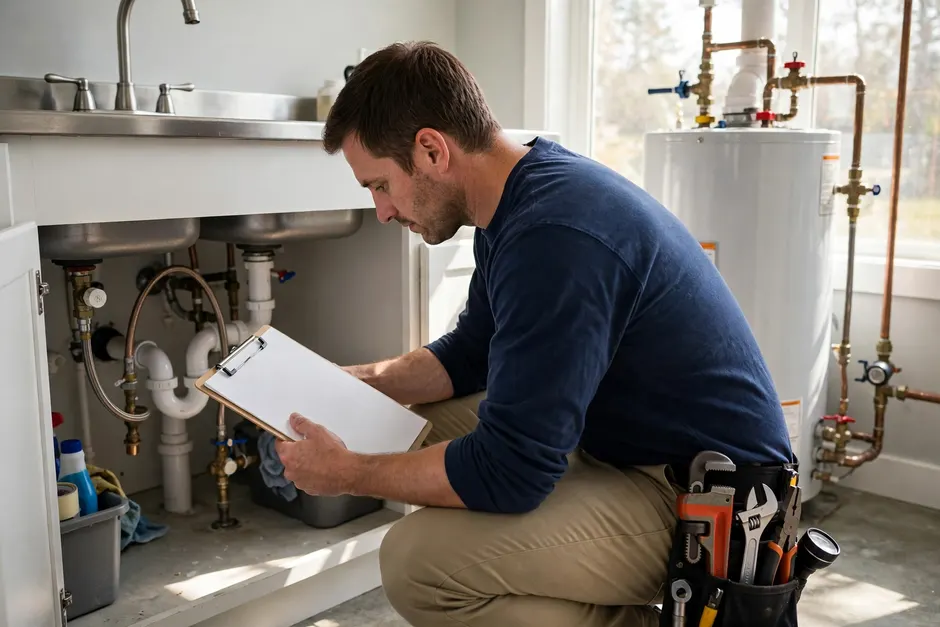
While heaters are the topic: the anode rod is a metal rod inside the tank that corrodes so the tank does not. Our maintenance rhythm checks it every two to three years, and softener homes should hold that schedule firmly, because softened water often consumes rods faster. A rod reduced to a wire with lumpy remains has done its job and needs replacing. A rod ignored until it is gone leaves the tank lining as the next thing the water eats. Homeowner stories about corroded fittings and rusted expansion tanks belong to this same family of quiet, checkable wear.
Is all this an upsell, as some homeowners reasonably ask? On a healthy mid-life tank, no: it is the cheapest life-extension the unit will ever get. On a tank already at the end of its life, flushing money may indeed be wasted, and a straight answer about replacement serves you better. A good maintenance visit tells you which tank you own before it sells you the flush.
When to let us do it instead
Book the flush as part of a maintenance visit if the drain valve has not moved in years, if the heater sits in a closet or attic where a spill travels, if the unit is gas and you are not confident relighting it, or if you want the anode, relief valve and expansion tank checked in the same trip. The visit bundles the whole heater health picture into one set of findings, most of them reassuring, all of them written down.
| Your situation | What it points to |
|---|---|
| Average home, town water | Flush yearly |
| Very hard water or heavy use | Flush every six months |
| Softener fitted | Yearly flush, anode check every 2 to 3 years |
| Ancient tank, never flushed | Ask for an honest assessment first |