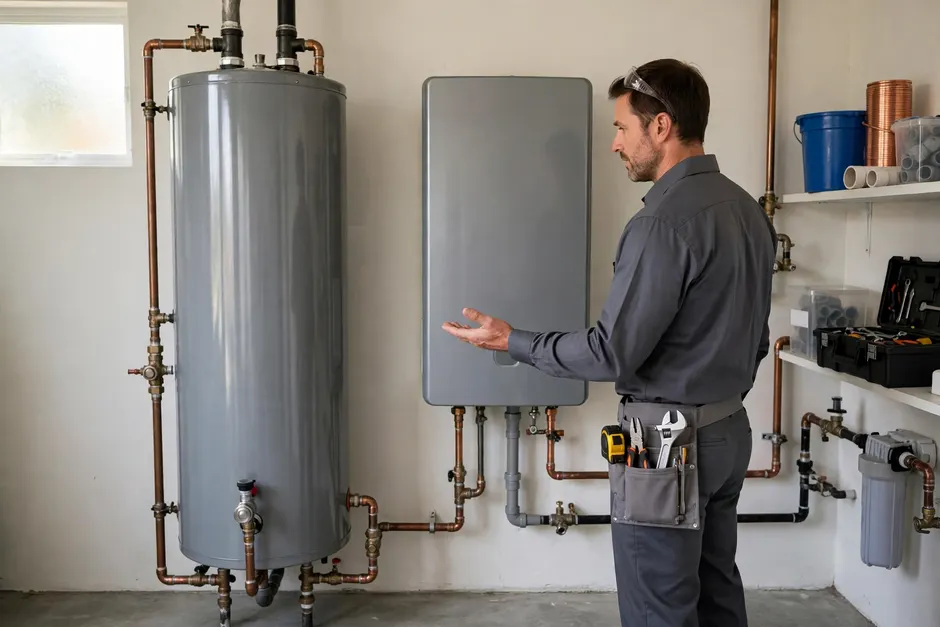
Neither wins everywhere. A tank heater is simpler, cheaper to fit, and forgiving of our hard water when it is flushed yearly. A tankless unit saves space and standby heat, and supplies water as long as you draw, but it must be sized for a Tennessee winter peak and descaled about yearly in limestone water. Your household pattern, fuel supply and appetite for maintenance decide it, and this article weighs each factor plainly.
How each one actually behaves
A tank heater keeps a store of hot water ready and reheats it as it cools, losing a little heat around the clock, which is the standby loss tankless advocates rightly criticise. A tankless unit fires only when a tap opens and heats water on its way through, so its ceiling is not volume but rate: draw more gallons per minute than it can lift to temperature, and the shower cools. In a Middle Tennessee January, incoming water is at its coldest, so the same unit that felt endless in July is working at its honest limit in winter, and sizing must be done on the January figures.
Recovery tells the other half. A tank that empties needs time to reheat its store, so back-to-back baths plus laundry can outrun it. A tankless unit has nothing to refill; it simply needs its flow ceiling respected. Big Thompson's Station homes solve this either way they choose: a larger or faster-recovery tank, twin tanks, a properly sized tankless, or a tankless with recirculation for far bathrooms.
Our water changes the maths
Limestone scale is the local tax on both designs, collected differently. In a tank it settles as sediment that a yearly flush mostly removes, and the failure it causes is gradual. In a tankless exchanger the passages are narrow, so scale restricts flow and swings temperatures sooner, and the remedy is a yearly descale with a pump and solution. Skipping maintenance is not a neutral choice in Williamson County; it is a decision to let the water redecorate the inside of your heater. Owners who enjoy a service rhythm get excellent service from either design. Owners who want to forget the appliance entirely for a decade are usually happier with a tank, honestly flushed when reminded.
Softeners tilt the field as well. Soft water slows scale in both, while asking more of a tank's anode rod. None of this is a reason to avoid either unit. It is a reason the sales conversation here should start with your water test, not with a brand catalogue.
Fitting cost and disruption, honestly framed
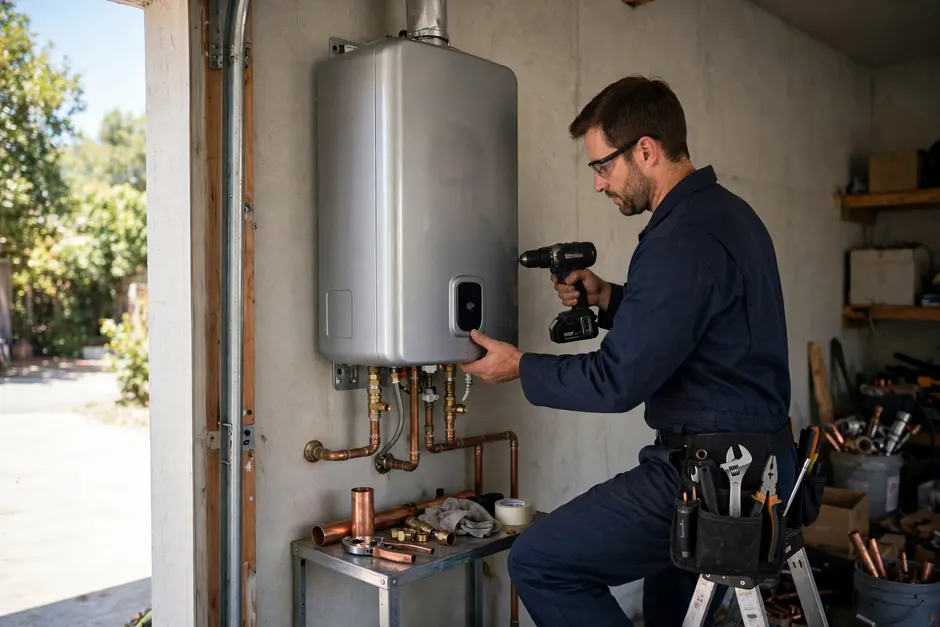
A like-for-like tank swap is the simplest and cheapest install in the business: same spot, same fuel, same vent or circuit. A tankless conversion usually adds work: larger gas supply or serious electrical capacity, new venting, a condensate drain on condensing models, and service valves for descaling. That difference is real money, and payback through lower standby losses depends on your fuel prices and habits, so be wary of any payback figure quoted without your bills in hand. What tankless reliably buys is space and an end to the empty-tank wait. For some June Lake and Littlebury homes freeing a closet, that alone settles it.
Reliability expectations should be set plainly too. Tanks commonly serve around a decade in our water, sometimes longer with care. Tankless units are often built for a longer service life, with replaceable parts, provided the descaling happens. Both statements come with ranges wide enough that your maintenance rhythm matters more than the badge on the front.
A simple way to decide
Choose a tank if your household draws hot water in big, bunched loads, if you want the lowest fitting cost and simplest upkeep, or if your gas or electrical supply would need expensive upgrading for tankless. Choose tankless if space is precious, if your use is steady and spread through the day, if you are tired of the last shower going cold, and if a yearly descale sounds like a fair trade. Then let a sizing survey, on winter figures and your real peak, confirm the choice before money moves. That survey is what our installation and tankless pages are for.
| Factor | What it points to |
|---|---|
| Upfront fitting cost | Tank lower, tankless conversion higher |
| Running pattern | Tank: standby loss. Tankless: heat on demand |
| Hard-water upkeep | Tank: yearly flush. Tankless: yearly descale |
| Best suited to | Tank: bunched loads. Tankless: steady loads, tight space |