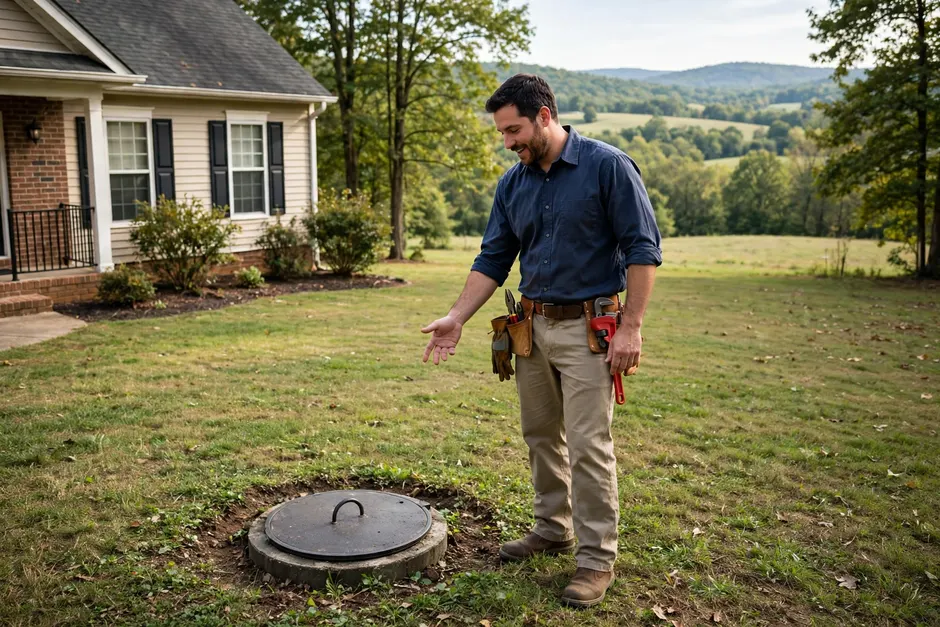
Both, depending on your street. Part of Thompson's Station connects to the town wastewater system, treated at the town's regional plant on Columbia Pike, while other homes, often on larger lots, use on-site septic or STEP systems. Which one you have decides where your sewer line runs, who is responsible for which stretch, and what a backup usually means. Your closing paperwork or the town can confirm it in minutes.
How the town's split came about
Thompson's Station grew from a small railroad town into one of Williamson County's fastest-growing communities, and sewers grew with it in stages. The town operates a regional wastewater treatment plant on Columbia Pike, and its collection system serves part of the town, expanding as development demands. Homes beyond the collection area, including many on acreage along the older roads, handle wastewater on site with septic tanks and drain fields, and some developments use STEP systems, where a tank at the home pumps effluent into a shared line.
That history is why two Thompson's Station houses a mile apart can have opposite answers to a sewer question. Neither is better in the abstract. A town connection means a utility manages treatment and the main. A septic system means the treatment plant is yours, in your yard, with a maintenance rhythm of its own. The problems each produces are different, and so are the first phone calls.
What a backup usually means on each system
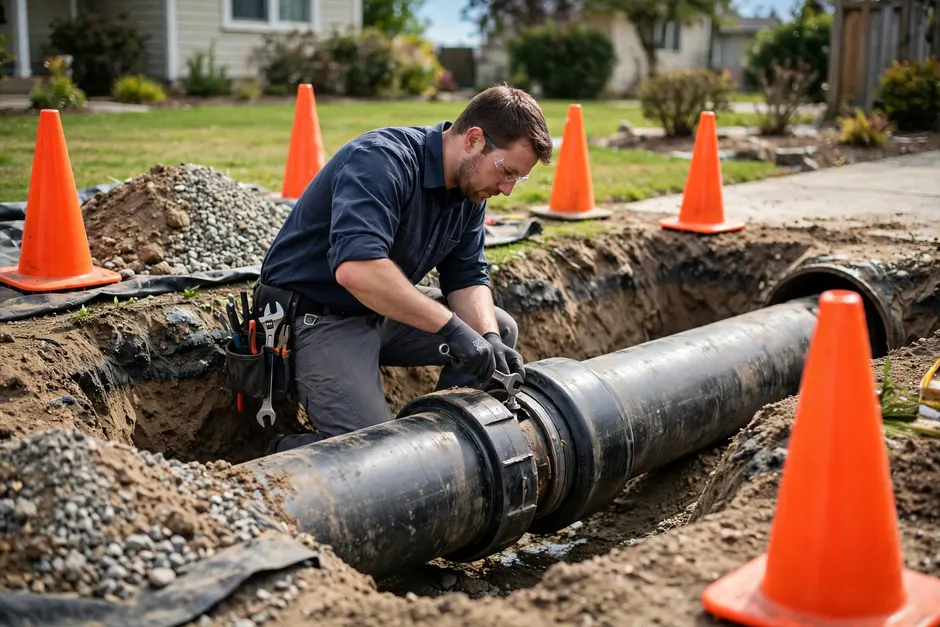
On town sewer, a whole-house backup with every fixture affected often traces to your lateral (the pipe from house to the connection) blocked by roots, grease or a sag, and less often to a problem in the town main. The question homeowners ask in community groups (could it be the town's side?) is a good one, and it is answerable: if your neighbours on the same main are backing up too, call the town first. If it is only your house, the lateral is the suspect, and a camera inspection shows exactly where the fault sits relative to the connection point, which is also where responsibility changes hands.
On septic, the same symptoms split differently. A tank that is full, a blocked outlet baffle, or a saturated field after weeks of rain can all back a house up, and none of them is fixed by clearing the house drains. Our approach is sequential: prove the house lines and the run to the tank are clear, then hand you an honest referral to the septic side rather than selling pipe work for a tank problem. Heavy spring rain in the West Harpeth low ground is the season when marginal fields announce themselves, on both systems' edges.
Care and feeding, whichever you own
Town sewer homes: treat the lateral as yours, because it is. Keep grease out of it, know where your cleanout is, and camera-check a line that clogs on a rhythm. Septic homes: know your tank's location and size, keep its pumping schedule (a septic professional sets it from your household size), spread laundry through the week, and keep vehicles and new landscaping off the field. STEP homes: learn what your control panel's alarm means before it sounds at a gathering, and keep the number for the responsible utility or service provider on the fridge.
Common to all three: wipes are not flushable in any practical sense, whatever the packet says. They do not break down like paper, and they feature in a dreary share of the backups we clear across 37179, town, STEP and septic alike. The bin is cheaper than the callout, every time.
| Question | What it points to |
|---|---|
| Who treats the wastewater? | Town: the town plant. Septic: your tank and field |
| A backup, only my house | Lateral blockage, or septic tank/field issue |
| A backup, whole street | Likely the town main; call the town first |
| Who pays for the lateral? | The homeowner, to the connection point |