Repair when the tank is sound and the fault is a service part: an element, thermostat, ignitor, valve or anode. Replace when the tank itself is leaking or badly corroded, when the unit is old and the needed part is major, or when repairs are stacking up faster than the unit's remaining life justifies. Age alone does not decide it. Condition plus the cost of this repair, weighed against what is left, decides it.
The tank is the whole question
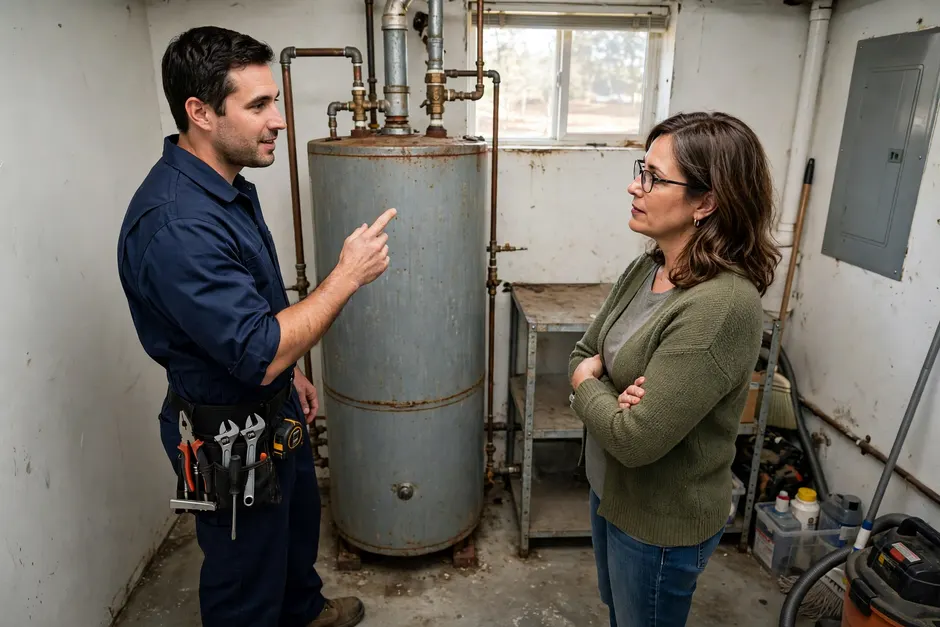
Everything bolted to a water heater can be replaced: elements, thermostats, gas controls, valves, anodes. The tank cannot. Its glass lining and steel shell are the appliance, and when they fail, shown by a leak through the body or deep corrosion at the seams and ports, every dollar spent on parts is spent on a vessel that is leaving anyway. That is why an honest diagnosis starts with the tank's condition, and why a technician who wants to fit an expensive part should first be able to tell you, convincingly, that the tank deserves it.
Age frames the odds without settling them. In our hard Williamson County water, many tanks serve around ten years, well-kept ones longer, neglected ones less. A seven-year-old tank with a failed element is a repair all day. A thirteen-year-old tank with the same failed element deserves a pause: the part is cheap, but what else is queuing behind it? The answer comes from inspection (anode state, sediment load, corrosion at ports) rather than from the calendar alone.
Do the remaining-life sums out loud
Take the repair price and set it against the cost of replacement, then against the years the tank plausibly has left. A modest part on a tank with five good years ahead is cheap hot water. The same-priced repair on a tank with one uncertain year is expensive hot water, and a second fault next winter turns it into the worst of both worlds: repair money spent, then replacement money anyway. Multiply small probabilities honestly. If the anode is spent, the sediment is deep and a second part is already tired, the stack is telling you the ending.
There is also the failure-mode discount. A planned replacement happens on your schedule, with choices about size, fuel and efficiency, and a dry floor. An unplanned one happens at the tank's chosen moment, often with water where water should not be, and the choice narrows to whatever can be fitted that day. Owners of finished basements and upstairs heater closets in Thompson's Station price that difference correctly when they replace a tired tank a season early.
Cases that look alike and are not
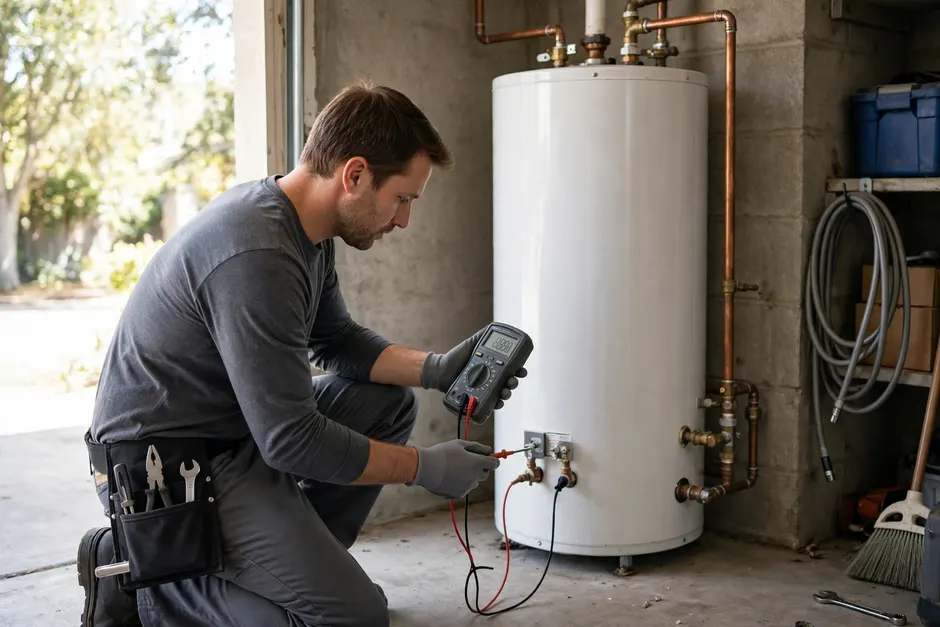
Two neighbours, two rumbling tanks. The first is eight years old, flushed never, anode half gone: flush it, anode it, and it likely serves years more, because its faults are maintenance debts, not mortal wounds. The second is the same age with rust weeping at the base seam and a relief valve that drips from pressure stress: that tank is not a maintenance candidate at any price. The rumble sounded identical from the kitchen door. Only the inspection separates them, which is why this decision should never be made from a symptom list alone, including this one.
Efficiency tempts people too, so let us be plain: replacing a working, repairable heater purely for efficiency rarely pays back quickly once fitting costs are counted, unless the old unit is also oversized, ancient or due for other work. Replace for condition and reliability. Let efficiency be the bonus you enjoy from a decision made on sounder grounds.
How we handle it in your home
We test, inspect and then show you: the fault, the tank's condition evidence, the repair price, and the replacement price, side by side. If repair is the sensible spend we will say so even though replacement is the bigger ticket, because a company that talks people out of needless replacements gets called for the replacements that are needed. If replacement is right, we size the new unit on your real use, and talk tank and tankless without a thumb on the scale.
| Finding | What it points to |
|---|---|
| Failed element, sound tank, mid-life | Repair |
| Tank body leaking at any age | Replace |
| Old tank, major part, anode spent | Replace, usually |
| Rumbling only, tank sound, never flushed | Flush and inspect, then decide |